

What Is Macrotia?
Macrotia is the medical term for ears that are disproportionately large compared with the rest of the head and face. The ear itself is overdeveloped: it is taller, wider or both. Most often, the excess is in the upper third of the ear (the scapha and the outer rim, called the helix), but in some people the earlobe is also long and heavy.
In adults, the average ear height is roughly 5.5–6.5 cm. Ears that are clearly taller than this, or that look large in proportion to the face, may be considered macrotia. Macrotia does not affect hearing, but its emotional impact can be significant, from teasing in childhood to self-consciousness in adulthood.
Macrotia looks different in different people. Some have a wide, flat upper rim; others have a large central bowl of the ear (the concha); others have a long earlobe; and some have a combination. Identifying exactly where the excess tissue lies is the first step in planning a natural result. I explain this further in my article what is macrotia? how to know if your ears are too large.
What Is Ear Reduction Surgery?
Ear reduction surgery, also called macrotia surgery, is a procedure that reduces the actual size of the outer ear. Excess skin and cartilage are carefully removed, and the remaining structures are reshaped so that the ear becomes smaller while keeping its natural folds and contours.
The goal is not simply to make the ear smaller, but to make it look natural and proportionate to your face. An ear that is reduced too much, or that loses its natural curves, can look artificial. This is why precise planning of the new dimensions is so important.
The ear is a delicate, three-dimensional structure of elastic cartilage covered by thin skin. Incisions are placed in the natural folds of the ear or behind it, so that scars are well hidden once healed. Most patients can wear short hair or tie their hair back without anyone noticing that they had surgery.
Why Is Ear Reduction Surgery Performed?
For most patients, the main reason is to feel comfortable with their appearance. Large ears can influence how people style their hair, how they pose in photos and how confident they feel in social and professional situations. Reducing the ears to a size that matches the face often brings a remarkable sense of relief.
There are also practical reasons. Some patients find that hats, helmets or glasses do not sit comfortably. With age, the skin and earlobes lose elasticity and stretch, so ears that were already large can appear even larger over time.
Above all, balance matters. When the ears are in proportion with the nose, jaw and face, people notice the face as a whole rather than one feature.
What Causes Large Ears?
In most people, large ears are genetic. The size and shape of the ear are inherited, and macrotia often runs in families. It can affect both ears equally, or one ear can be noticeably larger than the other.
Ageing also plays a role. The cartilage of the upper ear stops growing after adolescence, but the skin and soft tissue of the earlobe continue to lose collagen and elasticity. Gravity and heavy earrings make the earlobes longer over the years, so the whole ear can look larger in older age.
In rarer cases, abnormal development of the ear cartilage before birth or injury in childhood can lead to an overgrown upper ear or an enlarged concha. Whatever the cause, macrotia responds well to surgical correction.
Who Is a Good Candidate for Ear Reduction Surgery?
You may be a good candidate for ear reduction surgery if:
- Your ears look too large in proportion to your face
- The upper rim of your ear is wide or the ear is very tall
- One ear is noticeably larger than the other
- Your earlobes are also long or heavy
- You are in good general health
- You do not smoke, or are willing to stop before and after surgery
- You have realistic expectations
Because cartilage is removed, ear reduction is usually performed once the ears have reached their adult size, generally from about 15–18 years of age. There is no upper age limit for healthy adults.
Realistic expectations are important. Ear reduction creates a smaller, more balanced ear, but perfect symmetry between two ears is not possible, because no face is perfectly symmetrical.
How Is Ear Reduction Surgery Performed?
Ear reduction surgery is usually performed under local anaesthesia with sedation, or under general anaesthesia, depending on your preference and the complexity of the reduction. The operation takes about 1.5–3 hours.
Step 1: Measurement and Planning
I measure both ears, compare them with your facial proportions and mark exactly where tissue will be removed. The aim is to reduce the ear while keeping its natural shape.
Step 2: Incisions and Tissue Removal
Incisions are placed along the inner edge of the outer rim (helix) or behind the ear, where they are hidden in natural shadows. Through these incisions, a carefully calculated segment of skin and cartilage is removed. When the upper ear is the main problem, the scapha and rim are reduced. When the earlobe is also large, an earlobe reduction can be performed at the same time.
Step 3: Reshaping and Closure
The remaining cartilage is brought together and shaped with fine internal sutures, so the new framework is stable. The skin is closed with very fine stitches, and a soft compression dressing is applied around the head.
Reducing One Ear: Correcting Asymmetry
Not every patient has two large ears. Some people have one ear that is clearly larger, taller or shaped differently from the other. This asymmetry is often more noticeable in photos and when the hair is tied back.
In these cases, I usually reduce only the larger ear to match the other one. Planning is based on careful measurements of both ears, so the treated ear matches the natural ear as closely as possible in height, width and shape. Sometimes small adjustments to both ears give the most balanced result.
Treating one ear means a shorter operation and, usually, a lower cost. The recovery routine, with dressing and headband, is the same.
Preparing for Ear Reduction Surgery
Good preparation helps your surgery go smoothly and your ears heal well. Before your operation, I review your medical history and medications and examine both ears carefully.
In the weeks before surgery:
- Stop aspirin, anti-inflammatory painkillers, fish oil, vitamin E and similar supplements about 10–14 days before surgery, unless prescribed by your doctor.
- Stop smoking at least four weeks before and after surgery.
- Remove all earrings before surgery.
- Wash your hair the day before or the morning of surgery, as you will not be able to wash it normally for the first days.
- Prepare a travel pillow, a soft headband and comfortable tops that open at the front.
If you have any skin infection or eczema around the ears, it should be treated before surgery.
Ear Reduction Risks and How They Are Minimised
Ear reduction is a safe operation when performed carefully, but as with any surgery, there are possible risks. The most important early risk is a haematoma, a collection of blood under the skin of the ear. It usually causes sudden pain and swelling on one side and must be treated quickly. The compression dressing, blood pressure control and an early check reduce this risk.
Other possible risks include infection, delayed healing, visible scars, temporary numbness, mild asymmetry and, if too much cartilage is removed, an unnatural shape. Infection of the ear cartilage is uncommon but needs prompt treatment, which is why I prescribe antibiotics and follow my patients closely.
The best protection is a conservative approach: removing only what is needed, preserving the natural folds of the ear and protecting the blood supply of the skin. As an ENT surgeon, ear anatomy is part of my daily work, which helps me plan the reduction precisely.
Ear Reduction Surgery Recovery
Recovery after macrotia surgery is generally comfortable, but it requires care to protect the new shape of the ears.
- Days 1–2: A soft compression dressing protects the ears, reduces swelling and helps prevent a collection of blood under the skin. Keep your head elevated.
- Days 2–5: The dressing is replaced with a light elastic headband.
- Weeks 1–2: Wear the headband day and night. Stitches are removed or dissolve. Most patients return to desk work or school within 5–7 days.
- Weeks 3–6: Wear the headband at night to protect the ears while sleeping.
- Weeks 3–4: Return to normal exercise.
- Months 2–3: Avoid contact sports and activities where the ears could be pulled or hit.
- Months 6–12: Residual swelling settles, scars fade and the final shape is visible.
Avoid sleeping on your side for 4–6 weeks. A travel pillow can help you stay on your back. Mild numbness and itching are normal while the small skin nerves recover. I explain every stage in my article ear reduction surgery recovery: headband, sleep and flying home.
Ear Reduction Surgery Cost Turkey 2026: Prices and Packages
At my practice in Istanbul, the total ear reduction surgery cost in Turkey in 2026 ranges from $2,000 to $3,500, depending on the extent of the reduction, whether one or both ears are treated, whether the earlobes are reduced at the same time and the type of anaesthesia.
Your final ear reduction surgery cost Turkey is confirmed after we have assessed your ears, in person or from photos. You receive a clear, written quote with no hidden costs.
What Affects the Macrotia Surgery Cost in Turkey?
- Extent of reduction: Reducing the upper rim alone is simpler than reducing the rim, concha and earlobe together.
- One or both ears: Some patients have one larger ear and need only one side treated.
- Combined earlobe reduction: Adds to the operation time.
- Anaesthesia: Local anaesthesia with sedation or general anaesthesia.
- Surgeon’s experience: Reducing the ear while keeping natural folds requires detailed knowledge of ear anatomy.
What Is Included in the Ear Reduction Package?
- Surgeon’s fee, anaesthesia and operating room
- Pre-operative tests
- Medication, dressings and compression headband
- Follow-up visits and stitch removal
- Hotel accommodation in Istanbul during your stay
- Private airport, hotel and clinic transfers
- A patient coordinator and direct WhatsApp contact with me
International patients usually stay in Istanbul for about 5–7 days.
Why Is Ear Reduction Surgery More Affordable in Turkey?
Ear reduction surgery cost Turkey difference compared with the UK, Europe and the US mainly reflects lower operating costs, staff and facility costs and the exchange rate in Turkey. It does not mean lower standards. The surgical principles, sterile environment and aftercare are the same. What matters most is the surgeon’s experience with ear anatomy and a clear aftercare plan.
Ear Reduction Surgery Before and After
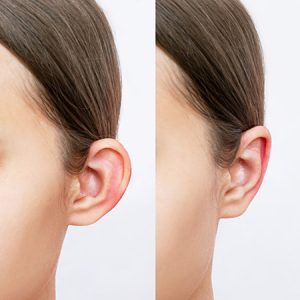
In “before” photos, the ears often dominate the profile: the upper rims may be wide and flared, the ears tall, or the earlobes long. In “after” photos, the ears are smaller, in proportion with the face, and the natural folds of the ear are preserved. Scars are hidden in the folds and behind the ear.
Many patients in their “after” photos wear short haircuts or tie their hair back, something they often avoided before surgery. You can see examples of my work in the gallery.
When you review before and after photos, look for natural ear shape, symmetry, well-hidden scars and ears that look proportionate rather than too small.
Ear Reduction Surgery Reviews and Patient Experiences
Patients who have had ear reduction surgery often describe a feeling of relief once healing is complete. Many say they wish they had done it earlier. A common comment is that friends rarely notice the surgery itself; they simply notice that the person looks more confident.
Patients also mention the less pleasant parts of early recovery, such as sleeping on their back and the itching that occurs as the skin heals. Knowing about these temporary inconveniences in advance helps you prepare.
When reading reviews, pay attention to how patients describe the naturalness of the result, the scars months after surgery and the support they received after returning home.
Are Ear Reduction Results Permanent?
Yes. Once cartilage has been removed and reshaped in an adult ear, it does not grow back. The new size and shape of the ear are permanent.
The skin continues to age, so the earlobes may stretch slightly over many years, especially with heavy earrings. Avoid heavy, dangling earrings and protect your ears from the sun to preserve your result.
Is Ear Reduction Surgery Painful?
You feel no pain during surgery, because the ears are fully numbed. After the anaesthetic wears off, most patients describe a dull ache or a feeling of pressure rather than sharp pain. This is well controlled with simple painkillers.
Discomfort usually decreases significantly within 3–5 days. Numbness or tingling may last a few weeks as the skin nerves recover. Keeping your head elevated in the first week reduces swelling and throbbing.
Is There an Age Requirement for Ear Reduction Surgery?
Because cartilage is removed, ear reduction is usually performed once the ears have reached their full adult size, generally from about 15–18 years of age. Older teenagers and adults also cope better with the recovery and the headband routine.
There is no upper age limit for healthy adults. Many patients in their fifties and sixties have ear reduction, often together with earlobe reduction to correct age-related lengthening.
Why Choose an ENT and Facial Surgeon for Ear Reduction?
The ear is part of my core specialty as an ENT surgeon. I work with ear cartilage, skin and blood supply every day, which helps me reduce the ear safely while preserving its natural folds and contours. My approach is conservative: a smaller, balanced ear that looks like it has always been yours.
Plan Your Ear Reduction in Istanbul
The first step is a personal assessment. Send me photos of both ears from the side and a front photo of your face with your hair tied back, and I will tell you what can be achieved and give you a clear, written quote. You can contact my clinic by WhatsApp or phone.